Compound Bow Stabilizer: Why Your Rig Wants One — and How Long to Go
Compound bows are where stabilizers earn their keep most obviously, because a modern compound is never just a bow — it's a bow plus a sight, a rest, a quiver, and sometimes a bow-mounted light or camera, all bolted to one side of the riser. This page covers what a stabilizer actually corrects on a compound, how to match a SteadyDraw carbon bow stabilizer length to your setup, and what the measured weights look like across all five sizes. If you want the ground-up explanation first, start with what a bow stabilizer does.
Why compound bows benefit from a stabilizer more than any other bow
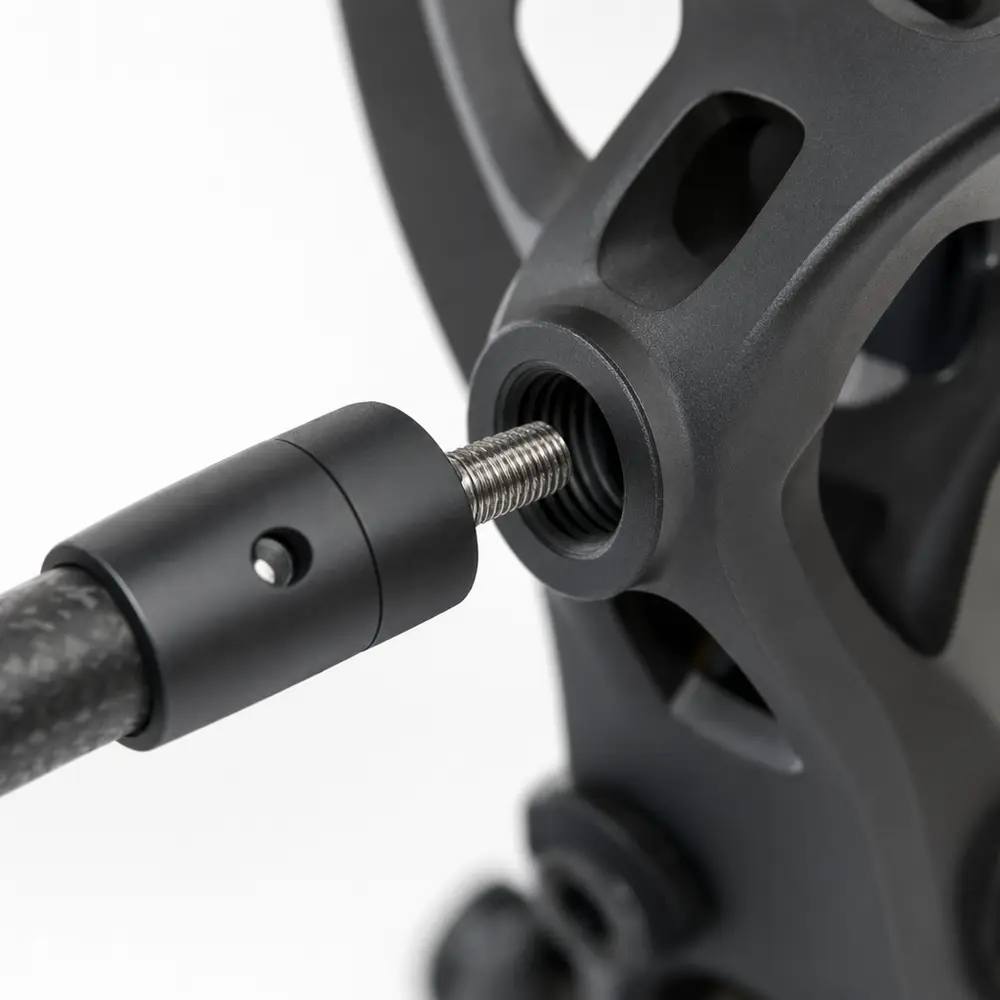
Hold an accessorized compound at full draw and watch your sight pin: it drifts in a lazy figure-eight, and it drifts more toward the heavy side of the riser. That's your sight and quiver pulling the bow off its centerline. Threading a weighted rod into the front bushing puts mass out along the line of the shot, which does two useful things at once. First, it moves the balance point forward and down, so the bow sits upright in your grip instead of leaning — less muscle spent fighting tilt means a calmer hold through the shot. Second, mass at the end of a lever arm resists rotation: the farther the stainless steel counterweight sits from your hand, the more it slows down every small twitch and torque input before it can move the pin.
Then there's the release. A compound's cams and limbs snap forward hard, and whatever energy doesn't ride out with the arrow rings through the riser. The SteadyDraw pairs its 3K carbon rod with shock absorbers and a built-in weight damping ball, so part of that leftover energy dies in the stabilizer instead of in your wrist. The honest way to describe the result — the same way we describe it in how we test — is a steadier aim, less pin float, and a quieter shot. We don't put a percentage on group sizes, because nobody can measure your shooting for you.
Hunting compound vs. 3D and target: two different length answers
This is the one decision that actually matters when you buy, and it's why the SteadyDraw is sold as one stabilizer, five lengths — pick by how you shoot. The trade is simple physics: every inch of rod moves the counterweight farther from your grip, which multiplies its steadying effect, but also makes the whole bow longer, slower to swing, and more awkward in tight cover. A target archer standing on an open line takes all the leverage they can hold; a bowhunter threading through oak brush takes only as much as fits.
| How you shoot | SteadyDraw length | Why it fits |
|---|---|---|
| Ground blinds, treestands, thick cover | 6" ($49.99) | Shortest and lightest (314.2 g); clears blind windows and shooting rails |
| All-around bowhunting | 8" ($52.99) | The classic hunting compromise: noticeably steadier than 6", still compact |
| 3D courses, western spot-and-stalk | 10" ($52.99) | Real leverage for longer, judged-distance shots; still packable |
| 3D and field rounds shot for score | 12" ($54.99) | Target-style stability without full target-line length |
| Target lines, backyard groups, training | 15" ($59.99) | Maximum leverage in the range; the steadiest hold of the five |
If you hunt, the dedicated hunting bow stabilizer page goes deeper on blinds, noise, and the 6–8" case. If you shoot a recurve or run a target-only setup, the recurve and target archery stabilizer page covers the 10–15" end. And the stabilizer length guide walks through the decision question by question.
SteadyDraw measured specs, length by length
| Nominal length | Measured weight | Measured dimensions (dia. × overall) | Price |
|---|---|---|---|
| 6" | 314.2 g (11.1 oz) | 3.9 × 23.9 cm | $49.99 |
| 8" | 319.2 g (11.3 oz) | 3.9 × 29.1 cm | $52.99 |
| 10" | 322.5 g (11.4 oz) | 3.9 × 34.1 cm | $52.99 |
| 12" | 330 g (11.6 oz) | 3.9 × 39.2 cm | $54.99 |
| 15" | 346.7 g (12.2 oz) | 3.9 × 47.2 cm | $59.99 |
Two honest notes on that table. First, the dimensions are manual measurements of the full assembly — counterweight and damper included — which is why a "6-inch" stabilizer measures 23.9 cm (about 9.4 in) overall; the nominal size names the rod format, not the total length. Second, notice how little the weight changes across lengths: only about 32 g separates the 6" from the 15". The stainless steel counterweight is the heavy part on every size, so going longer buys you leverage, not bulk — the 15" carries nearly the same mass as the 6", just much farther from your hand, which is exactly what makes it steadier.
Mounting on a modern compound riser
Installation genuinely is a thirty-second job, but setup deserves a little more thought than that. Once the rod is snug, draw the bow and check how it sits: a well-balanced compound should hold close to vertical without you muscling it there. If the top cam still wants to pitch forward or the bow leans toward your sight, that's normal tuning territory — the full walkthrough, including how to check your balance at full draw and when to pull the detachable damping ball, is in the stabilizer setup guide. One safety habit worth keeping regardless of setup: never draw on anything you don't intend to shoot, and never release a drawn string without an arrow — a dry-fire is the fastest way to wreck a compound.
Where the SteadyDraw sits among compound stabilizers
We compare the field openly in the best bow stabilizer comparison, and the short version holds no surprises: if you shoot registered target competition every weekend, a modular brand-name bar with micro-adjustable weights is worth its price. For the compound owner who hunts each fall and shoots 3D or backyard groups in between — which is most compound owners — the SteadyDraw covers the job at half the brand-name price, and buyers back that up. Verified purchasers so far rate it a straight 5.0 across 52 reviews; one buyer in Poland summed up the value position: "good quality product, not as expensive" as the brand equivalents. You can read the photo reviews on the reviews page.
Average monthly US searches for 'compound bow stabilizer' — the most-searched bow type for stabilizers
— DataForSEO keyword data, 2026
Average rating across 52 verified SteadyDraw buyer reviews
— SteadyDraw verified buyer data, 2026
SteadyDraw stabilizers sold to date across the five lengths
— SteadyDraw sales data, 2026
free shipping to the US · 30-day money-back guarantee
See how we test for the criteria behind every claim on this page.
Compound bow stabilizer FAQ
Do compound bows really need a stabilizer?
A bare compound will still shoot, so "need" is a strong word. But once a sight, rest, and quiver hang off the riser, the bow wants to tilt and twist in your hand, and every release dumps leftover energy into your grip as buzz and noise. A stabilizer counters that tilt and absorbs part of the vibration, which is why nearly every seriously set-up compound runs one.
What length stabilizer should I run on a hunting compound?
Most bowhunters land on 6 to 8 inches. That is long enough to settle pin float and take the sting out of the shot, but short enough to swing inside a ground blind, hoist into a treestand, and carry through brush without snagging. The SteadyDraw 6-inch weighs a measured 314.2 g and the 8-inch 319.2 g, so neither turns a hunting rig into a chore to hold.
Can one stabilizer work for both hunting and 3D?
Plenty of shooters compromise on a single 8- or 10-inch rod and shoot it year-round, and that works fine at a recreational level. If you shoot both disciplines seriously, though, the cleaner answer is one length per job: a 6- or 8-inch on the hunting rig and a 10- or 12-inch for 3D season. Since the SteadyDraw sells as one piece per order, some buyers simply order two lengths.
Will the SteadyDraw fit my compound bow?
Almost certainly. The SteadyDraw uses universal screw fittings that fit all modern risers — it threads into the standard accessory bushing on the front of the riser, the same mounting point every current compound manufacturer drills. Thread it in by hand until snug; no tools or adapters are required. If your bow has a front stabilizer bushing, it fits.
Related pages
The full five-length lineup and buyer selector live on the bow stabilizer homepage. For discipline-specific picks, see the hunting bow stabilizer and recurve bow stabilizer pages. For background, the what-does-a-stabilizer-do guide and the length guide cover the theory in depth.