Recurve Bow Stabilizer: Steadying the Shot Without a Full Target Rig
Recurve archery is the discipline where you feel a stabilizer most directly. There are no cams holding weight for you and usually fewer accessories masking the bow's behavior — just you, the string, and however steady your hold is through the release. This page covers what a stabilizer changes on a recurve, why the long end of the SteadyDraw five-length lineup fits target archery, and — honestly — where a 15" rod stands next to the 26–30" long rods you see at Olympic-style competitions. For the from-zero explanation, start with what a bow stabilizer does.
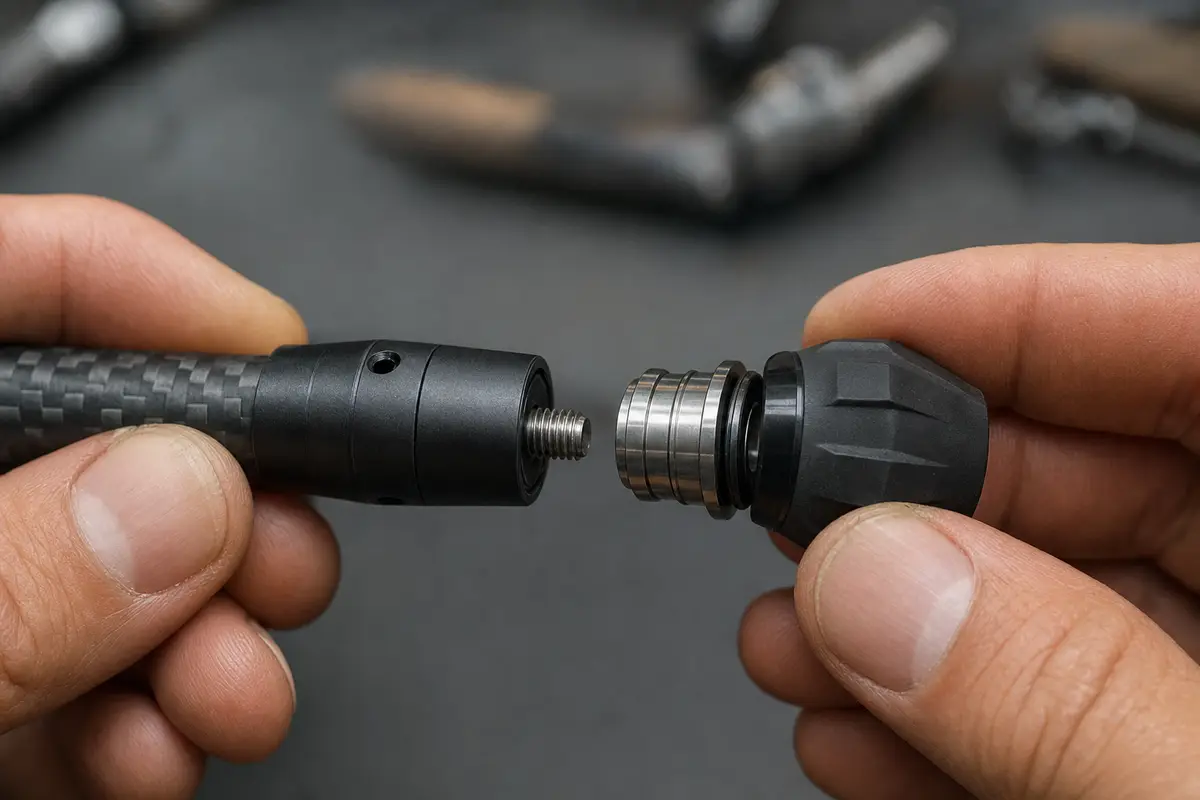
What a stabilizer actually does on a recurve
At full draw on a recurve you're holding the bow's entire draw weight while trying to keep a sight ring or arrow point still — and the longer you hold, the more the float grows. Mass out front resists that motion: the farther the SteadyDraw's stainless steel counterweight sits from your grip, the more it damps every small tremor and torque input before it moves your aim. This is the same physics that helps a compound bow stabilizer settle a pin, but recurve archers arguably feel it more, because nothing else on the bow is helping.
The second job happens after the clicker drops. A clean recurve release lets the bow jump gently toward the target; a stabilizer's forward mass encourages exactly that roll, while the 3K carbon rod, shock absorbers, and built-in damping ball absorb the vibration that would otherwise buzz through the riser. The honest description of the result is the one we always use: steadier aim, less float, a quieter and smoother shot. What no stabilizer can do is fix a collapsing release or shrink your groups by some marketable percentage — see how we test for why we refuse to publish numbers like that.
Why 10–15 inches suits recurve and target archery
Everything that pushes bowhunters toward short rods — the case laid out on the hunting bow stabilizer page — is absent on a target line. You're standing still, in the open, shooting deliberate arrows at a fixed distance. Under those conditions, more leverage is simply more steadiness, up to the limit of what your bow arm can support through a full session. The weight curve makes going long nearly free: all five lengths carry roughly the same mass, from a measured 314.2 g at 6" to 346.7 g at 15", so choosing the 15" over the 10" adds leverage without meaningfully more weight to hold up. For recurve archers shooting barebow-style for practice, the 10" is a popular compromise that keeps the bow feeling like itself; for sighted target work, the 12" and 15" earn their length. The length guide maps these choices question by question, and the setup guide covers balancing the bow once it's mounted.
| Length | Measured weight | Measured dimensions | Recurve / target fit |
|---|---|---|---|
| 6" | 314.2 g / 11.1 oz | 3.9 × 23.9 cm | Hunting rigs — see the hunting page |
| 8" | 319.2 g / 11.3 oz | 3.9 × 29.1 cm | Field carry, small risers |
| 10" | 322.5 g / 11.4 oz | 3.9 × 34.1 cm | Barebow-style practice, all-around recurve |
| 12" | 330 g / 11.6 oz | 3.9 × 39.2 cm | Club target shooting, training |
| 15" | 346.7 g / 12.2 oz | 3.9 × 47.2 cm | The steadiest hold of the lineup for target lines |
Weights and dimensions are manually measured, so slight deviations may occur; dimensions cover the full assembly with the counterweight end, which is why overall length runs past the nominal size. Prices run $49.99 to $59.99 depending on length, with free US shipping on every option.
Honest talk: a 15" rod is not an Olympic long rod
We'd rather draw this line ourselves than have you discover it later. Walk any Olympic-style shooting line and you'll see recurves wearing long rods roughly twice the SteadyDraw 15"'s length, balanced by side rods angling back past the archer's hips. That system exists because at the top of the sport, archers hold a level of steadiness a single mid-length rod can't reach — and they pay for it in cost, setup complexity, and a bow that no longer fits in a normal case. What a single 10–15" rod gives you is the majority of the everyday benefit — a calmer float, a smoother release reaction, a bow that balances instead of kicking — at $52.99–59.99, threaded on in thirty seconds. If your trajectory is national-level competition, budget for a long-rod system eventually and treat the SteadyDraw as your training and second-bow rod. If you shoot for score at a club, in your yard, or at 3D events, the honest answer is that a mid rod is all most archers will ever need. Our best bow stabilizer comparison names the brands worth that upgrade when the time comes.
Mounting on recurve risers — and the barebow caveat
Modern metal recurve risers — the kind sold as takedown target or field bows — carry the same standard front accessory bushing that compounds use, so mounting is identical: thread, snug by hand, done. The detachable damping ball can stay on or come off to taste; barebow-style shooters who train with the stabilizer and compete without it appreciate how fast the whole rod comes off. Safety basics apply as on any bow: never point a drawn bow at anything you don't intend to shoot, and never release a string without an arrow. One transparency note on our numbers: the SteadyDraw's 5.0 rating comes from its first 52 verified reviews — a small sample, reported as-is because every review received so far has been positive. Buyer photos, including a verified reviewer who noted "everything arrived intact, great stabilizer, well packaged," are on the reviews page, and there's more on the brand on the about page.
Combined average monthly US searches for 'recurve bow stabilizer' (210) and 'target archery stabilizer' (140)
— DataForSEO keyword data, 2026
Average rating across 52 verified SteadyDraw buyer reviews
— SteadyDraw verified buyer data, 2026
SteadyDraw stabilizers sold to date across the five lengths
— SteadyDraw sales data, 2026
free shipping to the US · 30-day money-back guarantee
See how we test for the criteria behind every claim on this page.
Recurve & target stabilizer FAQ
Can you put a stabilizer on a recurve bow?
Yes, if your riser has a stabilizer bushing — the threaded hole on the front of the riser below the grip. Virtually every modern metal recurve riser has one, and the SteadyDraw's universal screw fittings fit all modern risers. The exception is traditional one-piece wooden bows, many of which have no bushing at all; with nothing to thread into, no stabilizer will mount.
What stabilizer length is best for target archery?
On the SteadyDraw lineup, the 12" and 15" are the target picks. With no blind windows or brush to clear, target archery rewards leverage, and the longer rod places the stainless steel counterweight farther from your grip for a calmer float on the gold. Dedicated Olympic-style competitors eventually move to 26–30" long rods, but 10–15" is the honest, affordable middle ground for club and backyard target work.
Is the SteadyDraw 15" a competition long rod?
No, and we won't pretend otherwise. Competition long rods run 26–30 inches and anchor a full V-bar system with side rods. The SteadyDraw 15" is a short-to-mid rod: a single stabilizer that adds measured, meaningful steadiness to a recurve or compound without the cost or bulk of a full target setup. It's the right tool for club shooters, barebow practice, and training — not for the Olympic trials.
Are stabilizers allowed in barebow competition?
Generally no — that's part of what "barebow" means. World Archery barebow rules require the unstrung bow, minus permitted riser weights, to pass through a 12.2 cm ring, which rules out a mounted stabilizer rod. Plenty of barebow archers still train with a stabilizer to build a steady hold, then remove it to compete. If you shoot a sanctioned division, check your organization's current rulebook before mounting anything.
Related pages
All five lengths and the on-page selector are on the bow stabilizer homepage. Shooting a compound too? See the compound bow stabilizer page. Heading into the woods, the hunting stabilizer page makes the short-rod case, and the length guide ties the whole decision together.